
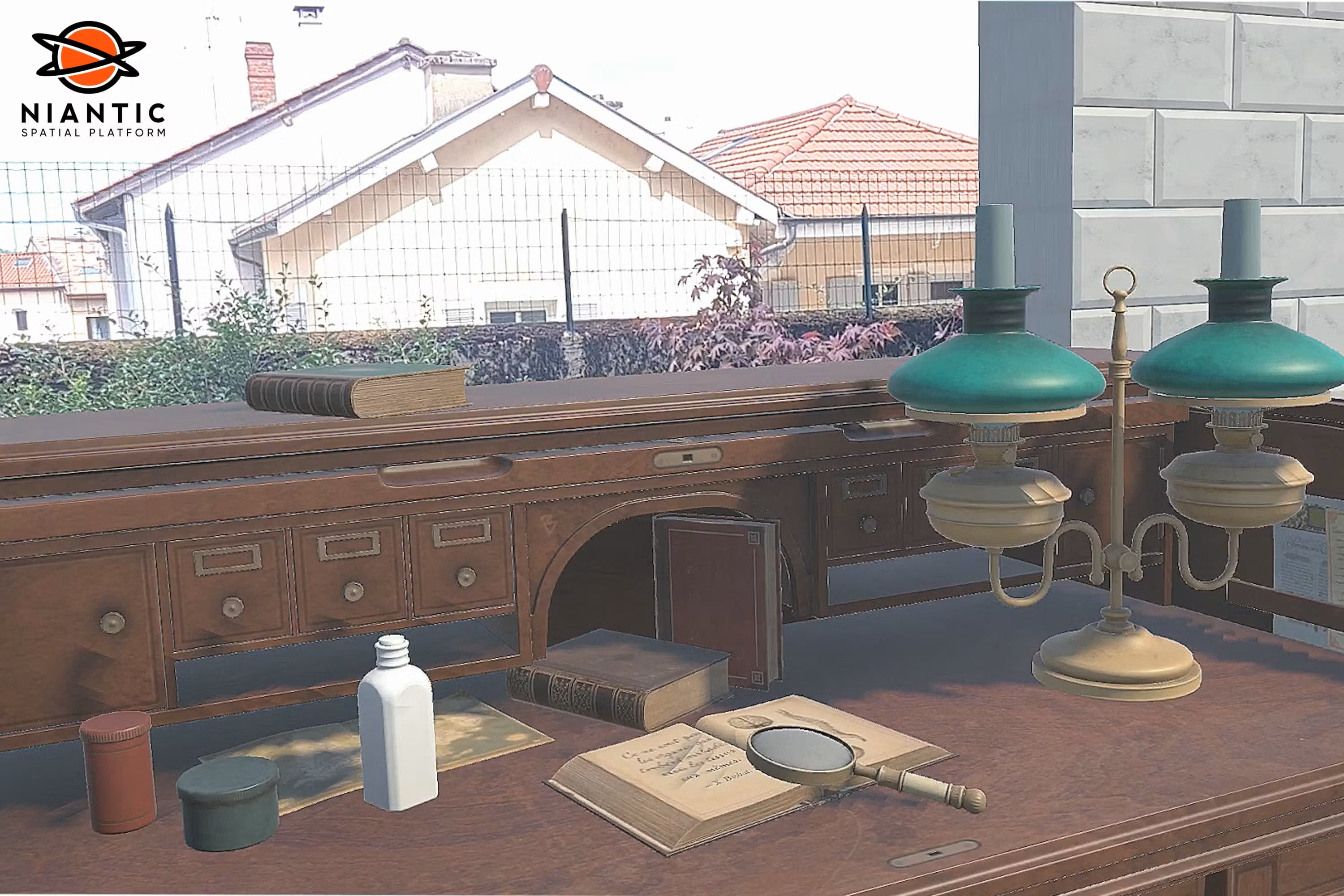
We recently conducted a targeted R&D project to evaluate the Niantic Spatial Platform in the field - scanning physical landmarks to create precise, consistent and reproducible augmented reality (AR) experiences on smartphones.
Our mobile developer Noa handled most of the implementation, assisted by Maël, an intern, who actively participated in the field surveys. The tests took place in Bourg-en-Bresse at several iconic locations around the city.
The Visual Positioning System (VPS)
The flagship feature of the Niantic Spatial Platform is the Visual Positioning System (VPS). While GPS alone delivers accuracy to a few metres - sufficient for navigation, but unsuitable for accurately placing a virtual object - VPS can shrink that margin to just a few centimetres.
Our main target was the statue of Dr. Xavier Bichat (1771–1802), a renowned French physician, located in the Jardin du Bastion, just a few minutes from our office.
From iOS LiDAR to Scaniverse on Android
Until recently, creating a VPS point with Niantic tools was done almost exclusively on iOS, ideally with a device equipped with a LiDAR sensor. The old Lightship scan app directly leveraged this depth data to produce a precise, textured 3D mesh in real time.
With the arrival of Scaniverse on Android, scanning now relies on photogrammetry: a technique that reconstructs geometry by analysing a series of images taken from different angles. The process first produces a point cloud - each point representing a position and colour in space - which is then transformed into a mesh for use in Unity.
Sites scanned
For this study, we scanned several sites in community mode with Scaniverse:
- The Xavier Bichat statue
- Vila Marguerite
- The NDSE column (Notre Dame de la Sainte Espérance)
- A wooden turnstile
- A turtle sculpture
- A Roman column
- A stele and other local points of interest
Unity integration and results
After the statue was carefully scanned and its VPS point activated by Niantic, we integrated the resulting mesh into a Unity 3D project. Our goal was to measure both the speed of VPS detection and the accuracy of 3D object placement, whether static or animated.
We designed an AR scene showcasing the statue, featuring:
- A virtual wall with an opening revealing the real background behind
- A chain barrier encircling the plinth
- Several strategically placed dynamic 3D elements
The tests showed that virtual objects remained stably aligned with centimetre-level precision. VPS lock-on occurred within 1 to 3 seconds - fast enough to preserve immersion.
About Niantic
Niantic is the company behind Ingress and Pokémon GO. Founded within Google in 2010 and becoming independent in 2015, they opened their AR SDK to developers in 2021. In early 2024, Niantic sold their video game business to Scopely for $3.85 billion, now refocusing on geospatial AI under the name Niantic Spatial Inc.
This R&D study is part of our ongoing exploration of immersive and spatial technologies - a field that opens up concrete possibilities for client projects in the region and beyond.